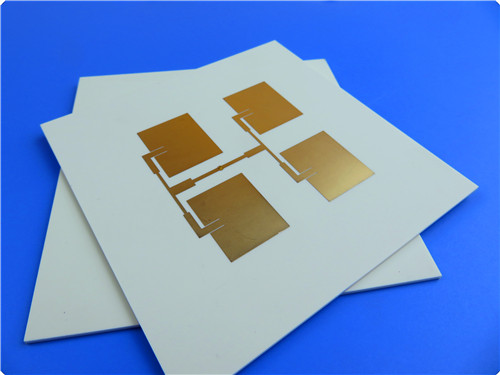
AL₂O₃ Ceramic PCB - Double-Layer Board, 1mm Thickness, Immersion Gold
1.PCB Construction Details
| Base Material | AL2O3 (96%) Ceramic Substrate |
| Layer Count | Double-sided |
| Board Dimensions | 100mm x 100mm ± 0.15mm |
| Minimum Trace/Space | 5/6 mils |
| Minimum Hole Size | 0.4mm |
| Blind Vias | No |
| Finished Board Thickness | 1.1mm |
| Finished Copper Weight | 1oz (1.4 mils) for outer layers |
| Via Plating Thickness | 20 μm |
| Surface Finish | Immersion Gold |
| Top Silkscreen | No |
| Bottom Silkscreen | No |
| Top Solder Mask | No |
| Bottom Solder Mask | No |
| Electrical Testing | 100% Electrical Testing conducted prior to shipment |
2. PCB Stackup: 2-Layer Rigid PCB
| Specification | Details |
| Copper Layer 1 | 35 μm |
| Ceramic AL2O3 96% Core | 1.0 mm |
| Copper Layer 2 | 35 μm |
3. PCB Statistics
Components: 16
Total Pads: 33
Through-Hole Pads: 25
Top SMT Pads: 17
Bottom SMT Pads: 0
Vias: 22
Nets: 2
4.Accepted Standards
Artwork Format: Gerber RS-274-X
Quality Standard: IPC-Class-2 compliant
Availability: Worldwide production and shipping
5. Typical Applications
(1).Aerospace Field: Ceramic PCBs are ideal for spacecraft and satellites due to their exceptional high-temperature resistance and radiation tolerance, ensuring reliable operation in extreme environments.
(2).Automotive Electronics: Their high-temperature, shock, and corrosion resistance make ceramic PCBs suitable for automotive electronic control units and safety systems, enhancing vehicle safety and reliability.
(3).Energy Sector: In applications like solar panels and wind power generation, ceramic PCBs provide stable electronic support, ensuring efficient operation and long-term stability for renewable energy devices.
(4).IoT Technology: With the growing demand for miniaturization and high performance, ceramic PCBs are perfect for IoT devices in smart homes and transportation, driving the development of IoT technology.
(5).High-Power Electronics: They are essential in RF and microwave circuits, medical equipment, and industrial applications, offering stable support for high-temperature environments.
6. Introduction to AL2O3 96% Ceramic Material
AL₂O₃ ceramic laminates consist mainly of aluminum oxide (AL₂O₃), comprising over 96% of the material. Small amounts of additives like yttrium oxide (Y2O3) and magnesium oxide (MgO) enhance performance.
Density: 3.5-3.9 g/cm³, indicating substantial mass.
Hardness: Exceeds 9 on the Mohs scale, offering excellent wear resistance.
Thermal Conductivity: Typically 20-30 W/(m·K), providing commendable insulation.
Coefficient of Linear Expansion: 6-8×10^-6/°C, showcasing strong thermal stability.
7. Features
Density: ≥ 3.7 g/cm³
Warpage: ≤ 2
Surface Roughness: 0.2-0.75 μm
Thermal Conductivity: 24 W/mK
Coefficient of Linear Expansion: 6.5-8.0 × 10^-6/K
Dielectric Constant at 1MHz: 9-10
Breaking Voltage: 17 kV/mm
Volume Resistivity: 10-14 Ω·cm
Flexural Strength: 350 MPa
8. Benefits
High Resistance: Reduces current loss and heat generation.
Outstanding High-Frequency Performance: Ideal for communications and signal processing.
Effective Heat Dissipation: Prevents overheating.
Chemical Stability: Resistant to corrosion for long-term reliability.
Mechanical Strength: Endures vibration and high temperatures.
Precision Circuits: Maintains high accuracy during manufacturing.
High Current-Carrying Capacity: Handles large currents with minimal temperature increase.
Superior Insulation: Offers high voltage resistance for safety.
Strong Bonding: Ensures firm adherence between copper foil and ceramic substrate, preventing delamination.
|
.png)
.png)