Home > Newly Shipped PCB > Rogers RO4003C and FR-4 4-Layer 1.4mm High Frequency RF Microwave PCB ENIG

Rogers RO4003C-FR-4 4-Layer Hybrid PCB
PCB Material:Rogers RO4003C + High Tg FR-4 (TG175) / 1.4mm
MOQ:1PCS
Price:4.99-109 USD/PCS
Packaging:Vacuum / Anti-static Packaging
Delivery Period:7-15 working days
Payment Method:T/T, Paypal
 

Rogers RO4003C and FR-4 4-Layer 1.4mm High Frequency RF Microwave PCB ENIG


1.Introduction to RO4003C + FR-4 4-Layer Hybrid PCB

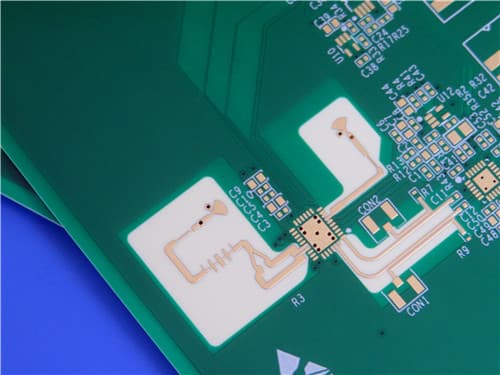
This 4-layer rigid hybrid PCB is constructed with Rogers RO4003C and High Tg FR-4 (TG175) as the base materials. RO4003C hydrocarbon ceramic laminates are designed to offer superior high frequency performance and low cost circuit fabrication. The result is a low loss material which can be fabricated using standard epoxy/glass (FR-4) processes offered at competitive prices. RO4003C material possesses the properties needed by designers of RF microwave circuits, matching networks, and controlled impedance transmission lines. Low dielectric loss allows RO4003C to be used in many applications where higher operating frequencies limit the use of conventional circuit board laminates. The board features immersion gold (ENIG) surface finish with 2 microinches gold thickness, green solder mask, white silkscreen, 25μm via plating thickness, IPC-Class-3 quality standard, and controlled depth routing. The finished board thickness is 1.4mm with board dimensions of 200mm x 115mm.


2.Key Features of RO4003C

Dielectric constant (process): 3.38 ±0.05 at 10 GHz / 23°C
Dielectric constant (design): 3.55 at 8 to 40 GHz
Dissipation factor: 0.0027 at 10 GHz / 23°C, 0.0021 at 2.5 GHz / 23°C
Thermal coefficient of Dk: +40 ppm/°C (-50 to 150°C)
Volume resistivity: 1.7 x 10¹⁰ MΩ·cm (COND A)
Surface resistivity: 4.2 x 10⁹ MΩ (COND A)
Electrical strength: 31.2 KV/mm (780 V/mil) at 0.51mm
Tensile modulus X: 19,650 MPa (2,850 ksi) at RT
Tensile modulus Y: 19,450 MPa (2,821 ksi) at RT
Tensile strength X: 139 MPa (20.2 ksi) at RT
Tensile strength Y: 100 MPa (14.5 ksi) at RT
Flexural strength: 276 MPa (40 kpsi)
Dimensional stability: <0.3 mm/m after etch + E2/150°C
CTE X-axis: 11 ppm/°C (-55 to 288°C)
CTE Y-axis: 14 ppm/°C (-55 to 288°C)
CTE Z-axis: 46 ppm/°C (-55 to 288°C)
Tg: >280°C (TMA method)
Td: 425°C (TGA method)
Thermal conductivity: 0.71 W/m/°K at 80°C
Moisture absorption: 0.06% (48 hrs immersion, 50°C, 0.060" sample)
Density: 1.79 g/cm³ at 23°C
Copper peel strength: 1.05 N/mm (6.0 pli) after solder float, 1 oz EDC foil
Lead-free process compatible: Yes


3.Benefits of This 4-Layer Hybrid PCB

RO4003C hydrocarbon ceramic provides low dielectric loss for high frequency performance
FR-4 process compatible with standard epoxy/glass fabrication techniques
No specialized via preparation such as sodium etch required
CTE matched to copper for excellent dimensional stability
Low Z-axis CTE (46 ppm/°C) provides reliable plated through-hole quality even in severe thermal shock applications
Tg >280°C ensures stable expansion characteristics over entire circuit processing temperature range
Low moisture absorption (0.06%) for consistent electrical performance
High thermal conductivity (0.71 W/m/°K) for efficient heat dissipation
ENIG surface finish with 2μ" gold provides excellent solderability and corrosion resistance
IPC-Class-3 quality for high-reliability applications
Controlled depth routing for precise mechanical features


4.RO4003C + FR-4 4-Layer Hybrid PCB Construction Details

ItemSpecification
Base materialRO4003C (Rogers) + High Tg FR-4 (TG175)
Layer count4 layers
Board dimensions200mm x 115mm = 1PCS
Minimum trace/spaceNot specified in source
Minimum hole sizeNot specified in source
Blind viasNot specified in source
Finished board thickness1.4mm
Inner layer copper weight0.5 oz
Finished copper weight1 oz
Via plating thickness25 μm
Surface finishImmersion Gold (ENIG) with 2 microinches gold thickness
Top silkscreenWhite
Bottom silkscreenNot specified in source
Top solder maskGreen
Bottom solder maskNot specified in source
Controlled depth routingYes
100% electrical testNot specified in source
Accepted standardIPC-Class-3

4-layer RO4003C-TG175 FR4 Hybrid PCB


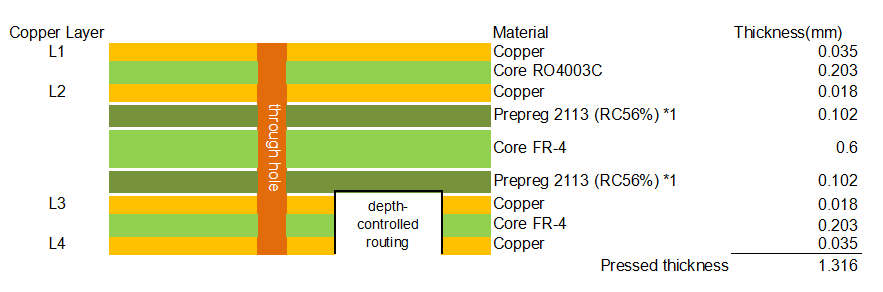
5.PCB Stackup (4-Layer Rigid Structure)

Copper layer 1 (Top): 1 oz (Finished copper)
Dielectric layer 1: RO4003C
Copper layer 2 (Inner layer 1): 0.5 oz
Dielectric layer 2: Prepreg / Bondply
Copper layer 3 (Inner layer 2): 0.5 oz
Dielectric layer 3: High Tg FR-4 TG175
Copper layer 4 (Bottom): 1 oz (Finished copper)

Finished board thickness: 1.4mm


STACKUP OF 4LAYER 4003C+FR4


6.Primary Application Areas

Cellular base station antennas and power amplifiers
Automotive radar and sensors
RF identification tags
LNBs for direct broadcast satellites
Microstrip and stripline circuits
Millimeter wave applications
Point to point digital radio antennas
Broadband applications


7.Quality Assurance

Artwork supplied: Gerber RS-274-X
Accepted standard: IPC-Class-2
Availability: Worldwide


8.RO4003C High-Frequency Laminate – Product Introduction

RO4000 hydrocarbon ceramic laminates are designed to offer superior high frequency performance and low cost circuit fabrication. The result is a low loss material which can be fabricated using standard epoxy/glass (FR-4) processes offered at competitive prices. The selection of laminates typically available to designers is significantly reduced once operational frequencies increase to 500 MHz and above. RO4000 material possesses the properties needed by designers of RF microwave circuits, matching networks, and controlled impedance transmission lines. Low dielectric loss allows RO4000 series material to be used in many applications where higher operating frequencies limit the use of conventional circuit board laminates. The temperature coefficient of dielectric constant is among the lowest of any circuit board material, and the dielectric constant is stable over a broad frequency range, making it an ideal substrate for broadband applications. RO4000 material's thermal coefficient of expansion (CTE) is similar to that of copper which allows the material to exhibit excellent dimensional stability, a property needed for mixed dielectric multi-layer boards constructions. The low Z-axis CTE of RO4000 laminates provides reliable plated through-hole quality, even in severe thermal shock applications. RO4000 series material has a Tg of >280°C (536°F) so its expansion characteristics remain stable over the entire range of circuit processing temperatures. RO4000 series laminates can easily be fabricated into printed circuit boards using standard FR-4 circuit board processing techniques. Unlike PTFE based high performance materials, RO4000 series laminates do not require specialized via preparation processes such as sodium etch. This material is a rigid, thermoset laminate that is capable of being processed by automated handling systems and scrubbing equipment used for copper surface preparation. RO4003C laminates are currently offered in various configurations utilizing both 1080 and 1674 glass fabric styles, with all configurations meeting the same laminate electrical performance specification.


9.Features and Benefits of RO4003C

FeatureValue
Material typeHydrocarbon ceramic (not PTFE)
Dielectric constant (process)3.38 ±0.05 at 10 GHz / 23°C
Dielectric constant (design)3.55 at 8 to 40 GHz
Dissipation factor0.0027 at 10 GHz / 23°C, 0.0021 at 2.5 GHz / 23°C
Thermal coefficient of Dk+40 ppm/°C (-50 to 150°C)
Volume resistivity1.7 x 10¹⁰ MΩ·cm (COND A)
Surface resistivity4.2 x 10⁹ MΩ (COND A)
Electrical strength31.2 KV/mm (780 V/mil) at 0.51mm
CTE X-axis11 ppm/°C (-55 to 288°C)
CTE Y-axis14 ppm/°C (-55 to 288°C)
CTE Z-axis46 ppm/°C (-55 to 288°C)
Tg>280°C (TMA method)
Td425°C (TGA method)
Thermal conductivity0.71 W/m/°K at 80°C
Moisture absorption0.06%
Lead-free process compatibleYes

Benefits:
Low dielectric loss allows higher operating frequencies
FR-4 process compatible with standard epoxy/glass fabrication
No specialized via preparation (no sodium etch required)
CTE matched to copper for excellent dimensional stability
Low Z-axis CTE for reliable plated through-hole quality
Tg >280°C for stable expansion characteristics over entire processing temperature range
Rigid thermoset laminate compatible with automated handling systems
Ideal for broadband applications


10.RO4003C Data Sheet

PropertyTypical ValueDirectionUnitsConditionsTest Method
Dielectric constant (process)3.38 ±0.05Z10 GHz / 23°CIPC-TM-650 2.5.5.5 Clamped Stripline
Dielectric constant (design)3.55Z8 to 40 GHzDifferential Phase Length Method
Dissipation factor0.0027Z10 GHz / 23°CIPC-TM-650 2.5.5.5
Dissipation factor0.0021Z2.5 GHz / 23°CIPC-TM-650 2.5.5.5
Thermal coefficient of Dk+40Zppm/°C-50 to 150°CIPC-TM-650 2.5.5.5
Volume resistivity1.7 x 10¹⁰MΩ·cmCOND AIPC-TM-650 2.5.17.1
Surface resistivity4.2 x 10⁹COND AIPC-TM-650 2.5.17.1
CTE X-axis11Xppm/°C-55 to 288°CIPC-TM-650 2.4.41
CTE Y-axis14Yppm/°C-55 to 288°CIPC-TM-650 2.4.41
CTE Z-axis46Zppm/°C-55 to 288°CIPC-TM-650 2.4.41
Tg>280°CTMA methodIPC-TM-650 2.4.24.3
Td425°CTGA methodASTM D3850
Thermal conductivity0.71W/m/°K80°CASTM C518
Moisture absorption0.06%48 hrs immersion, 50°C, 0.060" sampleASTM D570
Lead-free process compatibleYes

11.Some Typical Applications

Cellular base station antennas and power amplifiers
Automotive radar and sensors
RF identification tags
LNBs for direct broadcast satellites
Microstrip and stripline circuits
Millimeter wave applications
Point to point digital radio antennas
Broadband applications


12.What is a Hybrid PCB (High-Frequency Hybrid PCB)?

A hybrid PCB, also known as a mixed dielectric PCB, combines two or more different types of laminate materials in a single board construction. In this product, Rogers RO4003C (high-frequency hydrocarbon ceramic) is combined with High Tg FR-4 (TG175). This allows designers to place high-frequency circuits on RO4003C layers for optimal RF performance while using lower-cost FR-4 for non-critical layers, balancing performance and cost.


Advantages of Hybrid PCBs:
Cost optimization by using expensive high-frequency materials only where needed
Improved thermal management
Ability to combine different CTE materials in one board
Flexibility in design for complex multi-layer structures


Disadvantages of Hybrid PCBs:
More complex fabrication process requiring careful material matching
Potential registration challenges between different material types
Different material shrinkage rates may affect dimensional stability


13.Fabrication Guidelines for RO4003C:

Storage: Fully clad RO4003C laminates should be stored at room temperature between 50-90°F (10-32°C).

Inner Layer Preparation: RO4003C laminates are compatible with many pinned and pinless tooling systems. Copper surfaces can be prepared for photo imaging using chemical or mechanical processes. RO4003C materials are compatible with most liquid and dry film photo-resists and can be processed through develop, etch, and strip (DES) systems typically used to process FR-4 materials.

Multi-Layer Bonding: RO4003C laminates are compatible with many thermosetting and thermoplastic adhesive systems.

Drilling: Standard entry and exit materials can be used. Drilling speeds greater than 500 surface feet per minute (SFM) should be avoided. Standard geometry drills are preferred. Hole wall roughness ranging from 8 to 25 μm is expected.

PTH Processing: Desmear is typically not required for double-sided boards as the high Tg (>280°C) minimizes smear. If desmear is required, alkaline permanganate or CF4/O2 plasma process may be used. RO4003C materials do not require special treatments prior to metallization.

Final Metal Finishes: RO4003C laminates are compatible with OSPs, HASL, and most chemically deposited or electroplated finishes including ENIG.

Routing: RO4003C laminates are routed using carbide tools and conditions typical to processing traditional epoxy/glass materials.


Get a Quick Quote

Fill in the form below and our engineers will reply within 24 hours with technical specifications and pricing for Rogers RO4003C + FR-4 4-Layer 1.4mm Hybrid PCB.
No file chosen

Max 10MB/file: .zip, .pdf, .jpg, .png, .txt (multiple)

Your information is safe. We'll respond within 24 hours.

Previous Rogers RT/duroid 5880 FR-4 4-Layer 1.0mm High Frequency RF Microwave PCB ENIG

Next Shengyi SF202 2-Layer 0.118mm Flexible PCB FPC ENEPIG RA Copper